
Syrisk oud sammenlignet med andre oudtyper
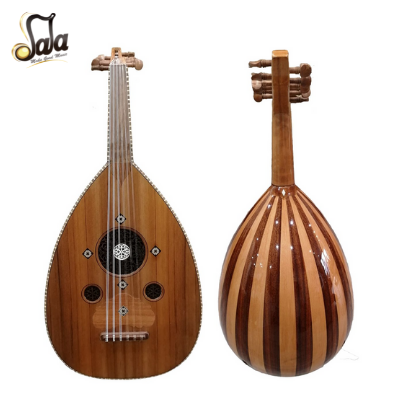
Syrisk oud hører til den brede arabiske oudtradisjonen. Mange modeller kombinerer en fyldig bunn med tydelig mellomregister og brukes til syrisk, levantinsk og klassisk arabisk repertoar. Det finnes likevel ingen enkel «syrisk standard»; mål og klang varierer mellom instrumentmakere.
Grunnleggende om oud

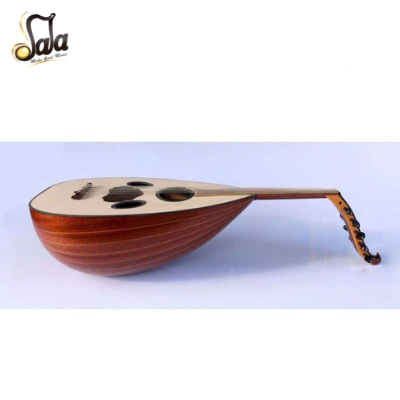
Oud er en korthalset, båndløs lutt med pæreformet skål. Strengene er samlet i kor og knipses med et langt plekter, risha. En vanlig moderne arabisk oud har elleve strenger i fem doble kor og én enkel bass, men tretten strenger og andre oppsett finnes.
Klangen oppstår i samspillet mellom soundboard, avstivning, skål, bro, mensur, strenger og utøverens anslag. Antallet lydhull eller mengden dekor avgjør ikke instrumentets geografiske type eller kvalitet.
Hva kjennetegner en syrisk oud?

Syriske ouds bygges vanligvis med fast bro og arabisk mensur og stemming. Mange er mellomstore til store, men faktiske mål må oppgis av produsenten. Klangidealet beskrives ofte som varmt, klart og balansert, med nok dybde til sangakkompagnement og nok definisjon til taksim.
Syria har hatt viktige instrumentmakertradisjoner i blant annet Damaskus og Aleppo. Hver instrumentmaker utvikler egne proporsjoner, avstivning og materialkombinasjoner. Derfor er det mer nyttig å vurdere det konkrete instrumentet enn å forvente at alle syriske ouds låter «tørre» eller «harde».
Andre oudtyper
Tyrkisk oud
Ofte mindre kropp, kortere mensur og høyere stemming. Klangidealet er gjerne lyst, raskt og briljant. Den trenger strenger beregnet for tyrkisk stemming.
Egyptisk oud
Ofte stor kropp og dyp resonans, med en bred og bassrik klang. Også her varierer mensur, lydhull og dekor mellom instrumentmakere.
Irakisk oud
Irakiske ouds finnes med tradisjonell fast bro og i moderne modeller med flytende bro. Flytende bro kan gi sterk projeksjon, rask respons og tydelig anslag.
Persisk barbat
Barbat er nært beslektet med ouden, men bygges og spilles innen persisk musikk med egne modeller og preferanser. Den bør ikke reduseres til bare en «mellomstor oud».
Elektrisk oud
Elektriske ouds kan være elektroakustiske, halvhule eller solid-body. Solid-body-modeller gir lite akustisk volum, men er praktiske ved høy scenevolum og bruk av effekter.
Syrisk oud mot de andre
| Type | Vanlig tendens | Kontroller spesielt |
|---|---|---|
| Syrisk | Balansert arabisk klang, ofte mellomstor til stor | Instrumentmakerens mål, avstivning og ønsket stemming |
| Egyptisk | Stor kropp og dyp, bred resonans | Fysisk komfort og bassbalanse |
| Tyrkisk | Mindre kropp, høyere stemming og klar respons | Kompatible tyrkiske strenger |
| Irakisk flytende bro | Direkte anslag og sterk projeksjon | Broplassering og riktig strengespenn |
| Barbat | Persisk bygging og repertoar | Modellens konkrete system |
Kjøpssjekkliste
- Be om mensur, kroppsmål, vekt og antall kor.
- Avklar ønsket arabisk stemming før du velger strenger.
- Lytt etter jevn balanse mellom bass, mellomregister og diskant.
- Kontroller bro, soundboard og fuger for sprekker eller løft.
- Prøv at stemmepluggene går jevnt og holder tonen.
- Velg et etui som passer nøyaktig til kroppen.
Hos Sala Muzik kan du sammenligne syriske ouds med andre regionale modeller ved hjelp av faktiske mål, lydprøver og strengeoppsett.


Good Afternoon Mr. Moran,
Thank you for reaching out with your inquiry about finding the perfect oud. It’s great to hear about your interest in exploring different styles beyond your Turkish oud.
Regarding the choice between Syrian, Iraqi, and Persian ouds, each has its unique qualities in terms of tone, timbre, and resonance. Typically, Syrian ouds are known for their warm, rich sound with excellent volume, making them very resonant. Persian ouds often exhibit a bright and clear tone, suitable for intricate melodic lines. Iraqi ouds, distinct for their floating bridges, offer a dynamic range of sound and allow for subtle tonal adjustments, which can enhance the instrument’s expressiveness. The floating bridge, indeed, adds a unique character by providing more vibration freedom, thus enriching the sustain and clarity of each note.
With a budget of £800, you are indeed in a good position to acquire a high-quality, professionally set up oud. The instrument I recommend, the Premium Arabic Oud Sala A9, falls within your budget and meets the criteria you described. It is hand-assembled and carefully checked to ensure a beautiful setup and sound. You can view and consider this model here: Premium Arabic Oud Sala A9.
https://salamuzik.com/products/premium-arabic-oud-sala-a9
As for the wood choices, each type offers different attributes:
Walnut: Known for its balanced tone, provides a warm yet bright sound.
Apricot: Rarely used but offers a lighter, very resonant tone.
Pamela: This wood is not commonly used in oud construction; perhaps you meant Padauk, which offers a rich and warm sound.
Cocobolo: Delivers deep and powerful tones with excellent sustain.
Purpleheart: Known for its density and stiffness, provides a vibrant and resonant sound.
For the soundboard, AAA cedar is an excellent choice known for its warm and clear sound, enhancing the oud’s overall tonality. An ebony fretboard and pegs not only add aesthetic value but also contribute to the clarity of the sound, thanks to ebony’s dense nature.
Please let me know if you need any more details or if there’s anything else I can assist you with. I’m here to help ensure you find an instrument that meets your artistic needs and inspires your music.
Kind regards
info@salamuzik.com
Good Afternoon, I wonder if you are able to help?
I am looking to buy an Arabic oud, and am thinking of getting either a Syrian, an Iraqi, or a Persian oud. Which would you say has the better range in tone, timbre, and sounds, and which has the most resonance and volume? (I already have a Turkish oud).
Also, does the Persian oud always have a floating bridge, and if so, is this a good thing improving the instrument? How does this affect the sound in contrast to a fixed bridge?
I am looking for a powerful Arabic sounding instrument, with lovely clear tonal ranges with sustain.
My budget is £800 UK sterling (US$950). Will I find a high quality hand assembled, beautifully set up and checked, professional instrument for this price? What are my options?
Lastly, I have also been looking at woods. Ideally I would like an ebony fretboard and pegs. For the sound board I am considering AAA cedar.
For the body I am unsure. What are your opinions of, and how would you describe the character of the following possibilities: Walnut; Apricot; Pamela; Cocobolo; Purpleheart woods?
Any advice would be very much appreciated.
Thank you.
Kind regards,
David Moran (UK)
The Strings are Nylon like a Classical Guitar so the tension will be fairly low. I find that Machine Head tuners are more practical than friction pegs cause w/ that many strings to keep in tune, Machine heads make a big difference. A built in tuner on an Oud also rocks because Nylon strings take a while to stretch, so it helps w/ tuning it to pitch.
I would like to add that the Moroccan ouds, besides the fact of being rare, are the direct descendant of the Andalusian oud developed by Ziryab starting from Oud Ramal, which could only be found in Andalusia (Spain) and northern Morocco.
The development of the modern Moroccan Oud through the centuries borrowed innovative wood working techniques from Italy, Greece, Germany and, of course, Turkey, Egypt, Syria, Iraq, and most of the middle-east. And in return new Oud architectures were exported to serve as a basis for other modern incarnations in the Oud playing countries.
The main characteristics of modern Moroccan Ouds can be summarized as follows:
- Tone versatility. The Moroccan Oud makers mastered the equalization techniques using innovative approaches to the structure.
- High power. The typical Moroccan Oud is a few decibels louder than its oroental counterparts.
- Higher basses without being “muddy”
- Excellent playability
- Wide choice of woods that the makers know how to handle
- Easy access to the best of the best of Moroccan walnut for the bowl, which is by far the most sought after material by professional recording artists.
- Tested and adopted by a wide range of famous artists, such as Said Chraibi, Farid Al Artrash, Mohamad Abd El Wahab, Tantawi, and many other professional artists and collectors.
I would like to see more Ouds from Morocco at Sala Muzik so our brothers and cousins around the world can enjoy this unique 10 centuries craftsmanship.
Legg igjen en kommentar